April 6th I turned a year older. I'm now 29 and a year a way from three decades of life provides a great oppotunity to look back on one's life and accomplishments and say "Who am I now, and how did I get here?"
Instead of doing that I took a week off work to play Assassin's Creed 2, buy a Dremel Tool to modify Nerf guns with my girlfriend, and purchased small bits or wood, fake plastic trees, and modeling clay from hobby shops to contruct sets for my table top gaming sessions. Do I need fantastic hand scuplted statues and personalized game pieces to get my players involved in the game? Of course not! And it's a good thing too, because my hand has never been the steadiest, my brother's the artist, I am the...well...something else equally creative and amazing I'm sure. But it did make me think, though I was making these pieces mostly because they were great opportunity to do something with my hands other then typing on a keyboard or clicking a mouse, what was so important about small custom made corridors and wooden hand-painted figures? The answer is simple. Immersion.
Immersion in a table top role playing game comes in many different forms. In a previous blog I'd mentioned the root of said games being fireside tales of high adventure, providing a great atmosphere with crackling fire wood smoke smells, and (usually) tastey food, players may get the sense that they aren't too much unlike their character counterparts, sitting around a cozy fire between perilous dungeons, regailing eachother with stories of adventure and excitment. Sadly, fireside adverturing games are hard to come by, given the space needed to both play the game combined to with space needed to safely manage an open flame. It
can be done, in fact there's a hundred things that can be done to make a game more special when you're commited to it, but it gets expensive. And after so much time your relationship with your players is like your relationship with a significant other, you want to find exciting locals and neat experiences to share together, but as time passes and you're more comfortable with each other, just doing it on the kitchen table is fine...
 |
When your player's characters look
like this, your players should feel
like this. |
...Aside from the the obvious memorable experience, immersion serves a very utilitarian purpose. If your group is at all like mine, they have been friends for years, and their Saturday night game is their night to catch up with said friends, talking about news and goings on throughout the week. "Non-game related" talk can be disruptive and distracting, and when you only have so much time in an evening to weave a tale of high adventure, all involved can shoot themselves in the feet by taking the time to sing
Guy on a Buffalo in four part accapella (Though a resourcful storyteller would capitalize on such events by forcing encounters on players where they have to sing or recite epic tales). This can be mitigated through time management, and immersion. An immersed player is focused, in character, and ready to play. So let's look at some immersion techniques.
Decription:
Description is the easiest and most basic form of immersion because it's going to happen some way or another. If you tell your players "The man you are speaking to is middle-aged, just under 6 feet tall, completely bald and below sparkling dark eyes and a large nose is a thick handlebar moustache and a crooked grin. Broad shoulders and a barrel chest fill his fine silk clothing, which is a deep green simple and elegant in design. He greets you warmly, introducing himself as Edgar Belmont, the man soon to become Baron of the city of Saxon and it's surrounding lands." you give them a pretty clear picture of what their looking at.
The alternative is to say, "A middle aged man approaches you, you note he is bald and has a large handlebar mustache. "I am Edgar Belmont" he says, the name familiar to you as you know he is soon to be baron of Saxon, a community known for it's export of fine silk. "Allow me to welcome you to Saxon and thank you for attending my coronation. I understand you're from York?"
Where the second gives less detail of the man, it does hint at enough to let the players for their own picture in their heads, they know he's probably wealthy given his position and are able to come up with their own "look" with limited features and indication of lifestyle, the important part of this description though is the way he speaks. Folks have a bias when hear about someone, which is different from when they see them, which is different from when they speak to them. The moment you open your mouth in chracter to your players, they will make their measure of the "person speaking" and decide whether they are a threat or an asset. Aside from interaction, very little description is needed for your players to fill in the blanks, and so immerse themselves.
Though this is the easiest way to immerse your players, long bouts of description turn into lecture (and soon to interuption). Describe away, but be prepared for your players to interupt and interact. Don't get angry when they interupt you to say "I'll take a closer look at that!" either ask them to let you finish or indulge them. If their interuption relavent to what you're describing you have them hooked! If not, ask them to save it for later.
Atmosphere:
 |
If your house looks like this, a little
atmosphere shouldn't be hard to create. |
Ambiance is a tricky thing, since most times you're looking at playing at a kitchen table, in a living room, or in a basement. Depending on what you're trying to convey with the feel of your adventure, you can stick with clever lighting tricks. A Dungeon crawl of an adventure could take place in a basement with no windows, and candle light. Stories of court intrigue could be hosted in well lit rooms with plenty of food and drink. A Kitchen lit (and stocked) properly could have a Taverny feel. I personally prefer a patio in fair weather. Fresh air does wonders for a party's ability to think, sounds of bugs and birds does well to lend to a frontier or wilderness motiffs. The few times I've been able to host on a patio, It's been very well received!
A word about lighting, dice and sheets are hard to read in dim light, make sure your playing space is well lit for players. Losing pencils, dice, and not reading abilites on a sheet is a problem. Your ambience should not get in the way of your game.
Tools:
When it comes to tabletop gaming, your experienced players have obviously taken their love of the game to the next level. First they did this by purchasing all the suppliment books that their game's publisher released to make money, then they started buying tools. Gaming tools can actually be split into two catagories, Playing Tools and Props.
 |
The Sultan, Lords and Ladies is it pricey, but if you're serious
about tabletop gaming, there is no finer table, until you go
with a touch screen. |
Playing Tools are hardware you may associate more with the storyteller, these are things that help the game at it's most basic levels. Truthfully, a group of gamers with the proper mental capabilities can run a game without paper, but it makes it easier when you have your character sheet, and some graph paper with a map drawn out, or instead a
Vinyl Mat with one inch squares,
Wet Erase Markers, and
Minitures of your specific player's characters. That second part probably sounds pricey. It is. But when you start to seriously consider these games as a hobby, spending a money on objects that define your character (as a player) is a personal touch that is worth it. As a storyteller, being able to use tools to shape a large map is quick, fun, and gives your players a very real image of dangers their facing and the situation their in. Sure your player's O's can be surround by X's on grid paper, or they could be hand painted figurines, with the likness of each specific character standing in a molded plastic dungeon, surrounded by wicked looking, die-cast lizard people with barbed spears. If you can afford it and you're commited, designing sets can be very rewarding for players and storytellers. There's also a large amount of free software available to allow you to run a digital game board, most of these are oriented to playing over the internet though, and few port well to a "T.V. based table top map".
 |
Outside and in costume, sure.
But crowded around a table in a kitchen,
foam swords quickly become
why we can't have nice things. |
Props are...tricky. Like a personalized figurine, perhaps your player arrives holding something relevent to his character. This sort of tool is neat because it begins breaching the realms between "gaming experience" and "performance art", unfortunatly it is also very dangerous. At best case scenario you have people sitting in cloaks with elf ears spirit glued on, worst case scenario one of your players shows up with a freshly sharpened
German Bastard Sword. Props to get your players into character are very cool, until your players get bored with sitting and decide to start swinging them at one another. You can try to tell them "act like adults!", but they
did just show up for a glorified playdate. If you invite props to your game, keep them non-weapon oriented, or have your players sign a waiver.
Again, KEEP IT SIMPLE. Having extravagent game sets or costumes can be very awesome, but remember that your players are here to play a game. If set peices and costumes gets in the way of playing, either throw the idea out...or instead of running the game have a costume party!
Media:
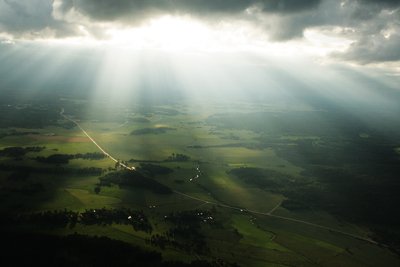
At it's simplest incarnation, media enters your game as the player character's pictures, but using visuals and sounds can add more ambience to an adventure. Visual queues such as pictures of exotic locations might do well to put your characters in the mind set of the area their exploring. Having a slide show running on a near by Television might be a nice touch.
 |
Amazing Lanscapse like this one can not only give you
Players a great image of the lands they roam, but can also
give you inspiration on what sorts of lands to
base your game around (Link to Original Piece) |
Sound can also be a huge boon. Having background music playing can be a nice touch. Though you want to tailor the music towards the game your playing, don't work too hard to match it. Background music in my experience has been as much a distraction as anything, prompting players to pull out their smart phones and decide which music they believe is better for the scene. Sound effects, though they seem like a good idea are just another thing to keep track of and somewhat cheapen the mood. When a player fails at something really important in game, having the Price is Right buzzer to punctuate it is funny only once.
Music proves for great inspiration outside the game though, I usually put together an unofficial soundtrack when I'm piecing games together, just something to inspire me while I'm creating encounters and story work. And for players, there's no reason why a character shouldn't have their own theme song!
Again, media like images and sound can be a one of your greatest tools for immersion, but just as easily become your greatest distraction. External media is also just another thing to keep track of outside the normal details you have to remember for your game (especially if you're the host!)
Ultimatly, immersion comes down to your players. You can enforce rules and add tools to help get folks into character, but if they feel like chatting about work and topics other then goblin slaying to blow off steam, there's not alot you can do to stop them. Again, the best thing to do is to let them get it out of their system, don't fight them to lead them back to the game. After a few minutes, everyone will remember what they're there for and want to get rolling. Frequent breaks and giving your players time to chat before getting started also helps to alleviate non-game related banter. Listeners recognize a great tale when they are free to, not when it's forced upon them, then it becomes a lecture.
In closing, truely authentic immersion is the greatest gift a storyteller can give to one of their listeners and vice versa. Imagine someone telling you the tale of Henry of York, a young Sword for Hire with a shadowy past, or Mika the Bard searching the world for ancient tales and lessons past, or Wren the Sorcerer, seeking fame, fortune, and most of all, a good time. Imagine being told their tales and when the tale is done you remember them like you were there, "like it was a dream, but it seemed so real". These memories and the lessons contained within are the gifts we storytellers share with the world. Humanity's most potent legacy is The Story, and every last man, woman, and child has a tale to tell.
Share your stories, but remember that when others are sharing to listen and let yourself be swept up in it, you might just learn something.